The Stochastic Trap
Why generic prompts yield average results, and how intent overcomes it.
Orientation for integrating AI into scholarly practice for researchers.

The AI tools available to academic researchers are evolving at an extraordinary pace — new models, new capabilities, new institutional platforms, and an entirely new class of agentic workflows. For practitioners in academic medicine, the challenge is no longer whether to engage with AI but how to do so with scholarly integrity, practical efficiency, and clear intent.
This site serves as the companion to The Practitioner's Compass workshop, offering a structured orientation organized around four cardinal directions:
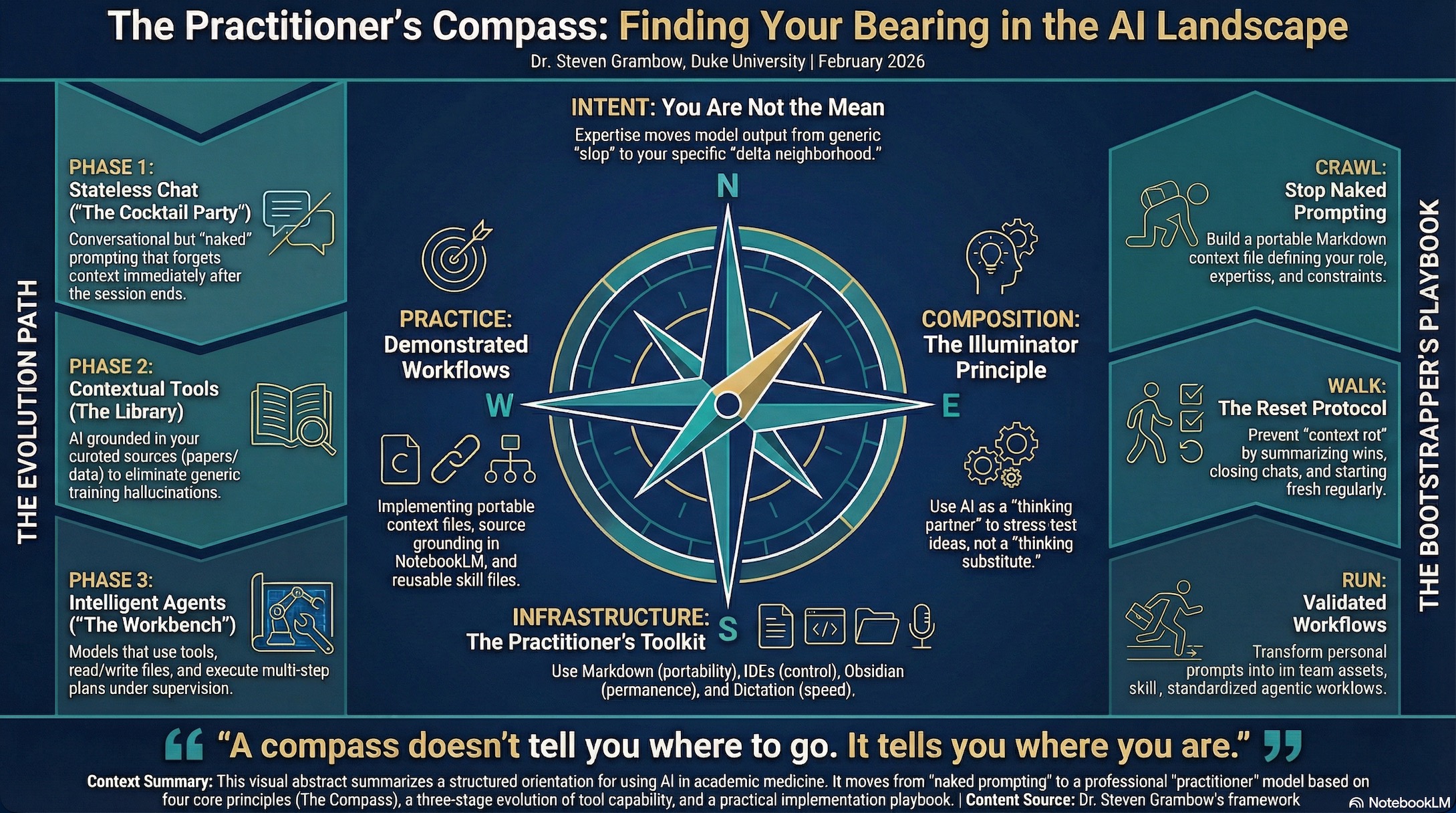
Large Language Models (LLMs) predict the most likely next token based on their massive training data. If you use a generic prompt, the model provides the most probable output. It regresses to the mean of its training data. And you are not the mean.
Your intent — your expertise, your specific questions, and your scholarly context — is what moves the model's output from the average to the precise region of the model's latent space where the outputs actually match what you need.
When most people use AI, they use it as a ghostwriter, offloading their cognitive work. Compositional AI is the opposite. You use the model the way Bell Labs scientists used Harry Nyquist — as an "Illuminator."
You come with your ideas and intent, and you ask the model to help you stress-test, refine, and sharpen them. The cognitive ownership stays with you.
Do not generate a finished draft. Instead:
Our goal is not a finished product, but a sharper version of my own thinking. Let’s begin.
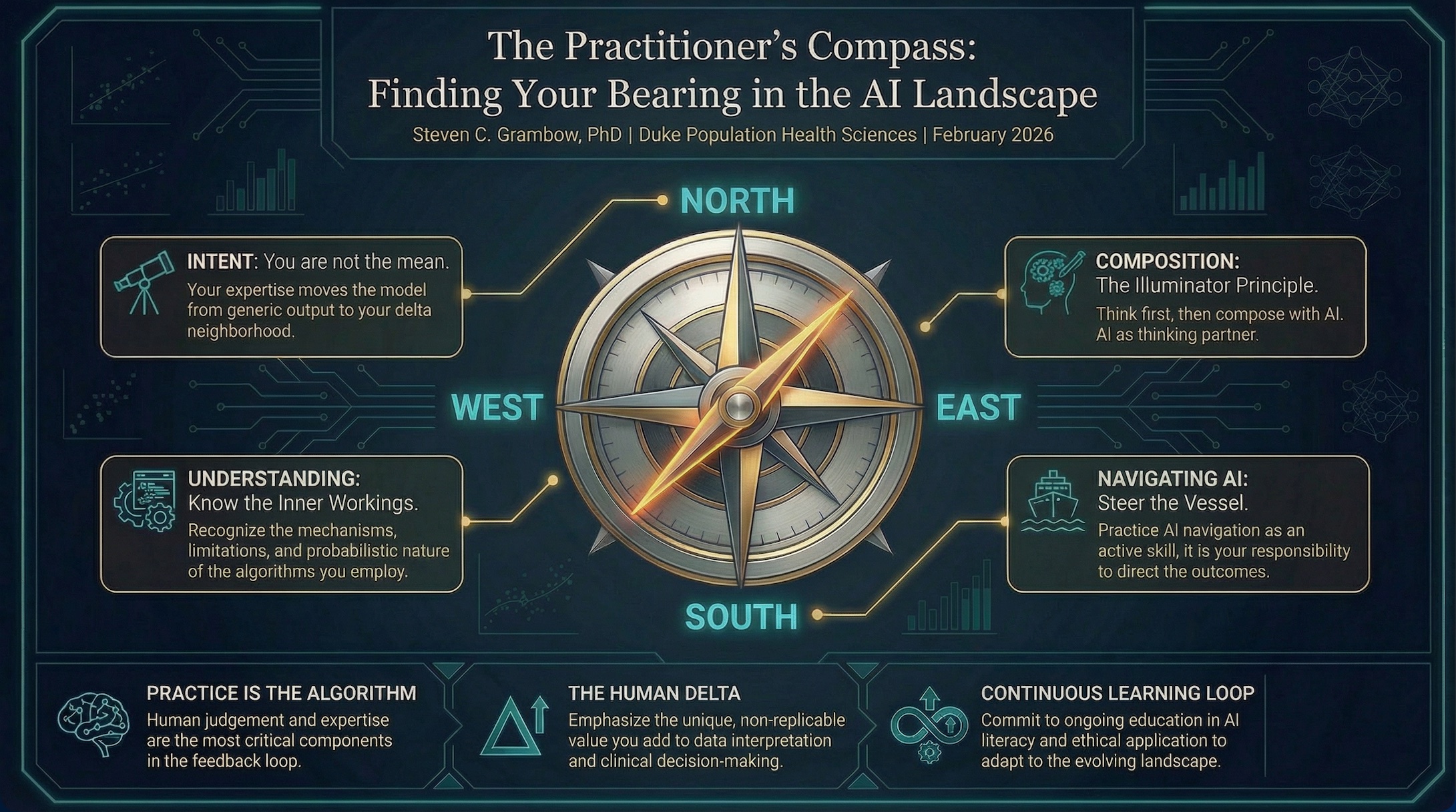
The author used multiple AI tools extensively in producing this presentation and the accompanying website. Opus 4.6 by Anthropic helped with slide creation and built most of the slide deck under the author's supervision. The infographics were primarily created by Google Nano Banana Pro through Google NotebookLM. Gemini Pro 3.1 was responsible for building the website. The podcast was created by Google NotebookLM. Written by a human. Boosted by AI. Transparency is part of the process.